This year marks the 100th anniversary of the birth of my late uncle, Percy Cutrer. To say that this man had an impact on my life would be an understatement. After my mother and father, Uncle Percy was and is a primal guiding spirit in my life. Both of my grandfathers passed away before I was born. He was old enough to be a grandfather and, while there is no 1:1 substitute for grandfathers, he often played that role when he wasn’t just being the “cool” uncle.
He was an artist, a traveler, a philosopher, and a voracious reader with seemingly infinite curiosity. I spent nearly every Sunday afternoon in his study, looking out over a veritable botanical garden that he cultivated around his little house on Highway 38 in Spring Creek, Louisiana. I always sat in the chair reserved for guests as Uncle Percy faced me in his swivel chair, mug of hazelnut coffee in hand, computer to his back, his full awareness and attention on me, us, our conversation. Whenever a question would come up for which we didn’t have an immediate answer, he would spin around and type with lightning speed at his computer, connected to the internet of the 1990’s to see what we could find to illuminate the shadows of our knowledge. Indeed, if it weren’t for Uncle Percy I would never have taken a liking to computers, and practically all of the skills that have sustained my career–what has put food on my table and a roof over my head–I trace back to those formative years just musing with Uncle Percy. The time I spent with him was worth more than my bachelor’s degree, and I say that not to devalue my undergraduate experience. But had it not been for Uncle Percy, I would not have had the curiosity and diligence to even complete the degree.
Whenever he greeted you at the front door, it was always with a beaming grin and an embrace full of love and life. You never knew where the conversation would lead you–we often explored topics as wide ranging as biology/botany, psychology, esotericism, religion, and of course art and literature–the passions that would come to define my adult life, and which had defined so many of his best years, particularly the time he lived in his beloved city of San Francisco (where he lived in the 1950’s, in time for the beatniks, missing the hippies by several years).
There is so much more I could say about this wonderful man, who left us in 2013. I still cannot believe he is gone–when I was a credulous teenager, I believed he would live well past 100. I could not properly grieve for him when he passed, and I have been carrying that grief ever since. It wasn’t until his youngest brother, my father, died in 2019 that I finally learned how to grieve.
Earlier this year, while organizing my papers, I found the following news article about Uncle Percy. The only copy I had was a photocopy of a clipping, poor quality, so I transcribed it and include it here for those who may be interested in reading more about him. I am sharing it here, 100 years after his birth, to honor his memory. I hope you enjoy learning about this incredible man.
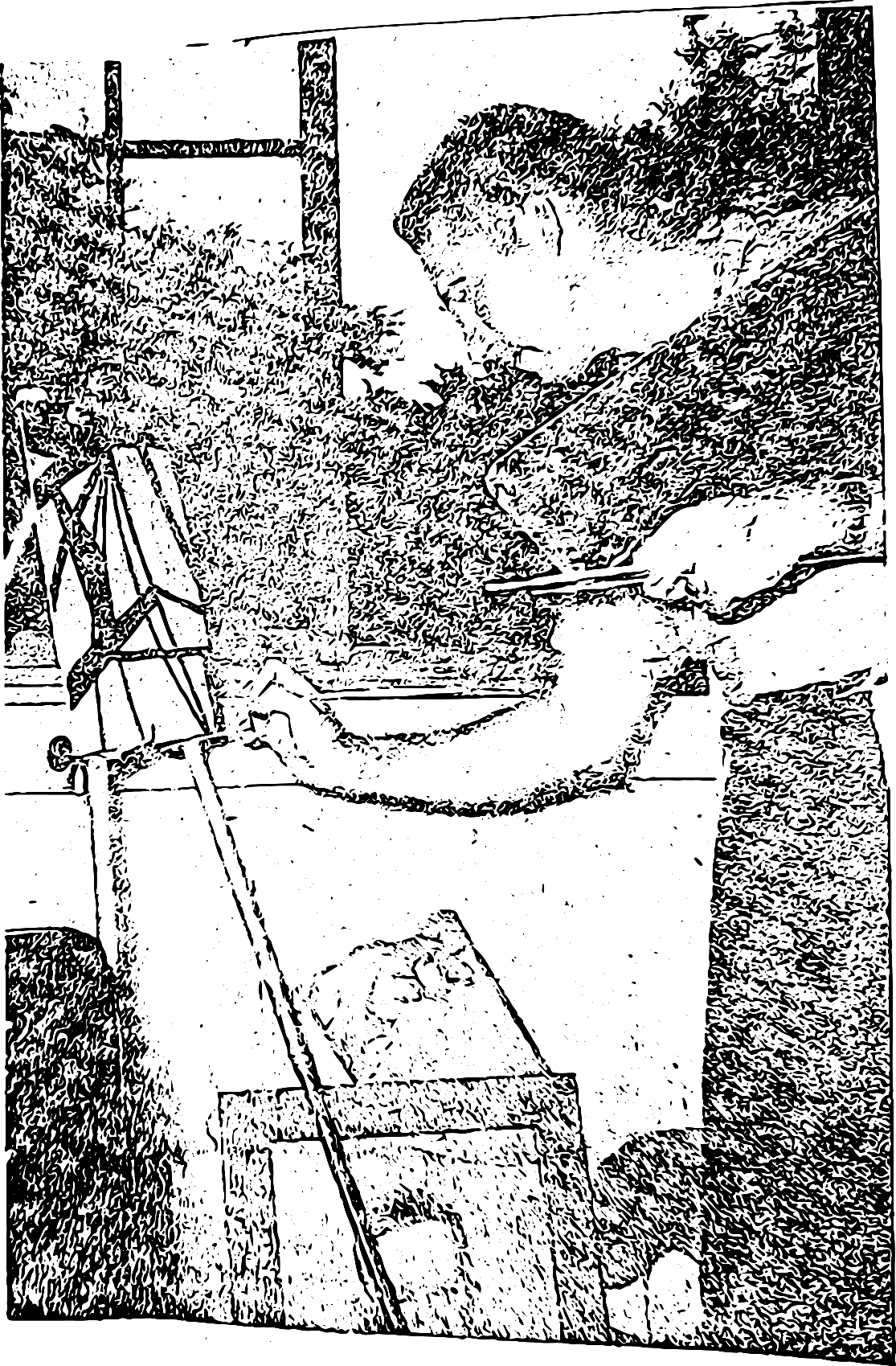
Piney Woods Painter of Tangipahoa Parish
By Dottye Varnado
Morning Advocate, Baton Rouge, Sun., Nov. 20, 1960
Typed by Kevin Cutrer, nephew of the artist, December 9, 2024
The upper end of Tangipahoa Parish offers a number of things to the native and visitor alike: for the artistic there are the haze-covered hills studded with grateful pines; for the adventurous, the area is replete with stories and sites of feuds among the hotblooded Scotch-Irish settlers that would hold their own with the legendary Martins and McCoys; for the practical there are the rolling fields of red clover where the cattle are sleek and fat; and for the hungry there are steaks, thick and juicy, that never heard of Kansas City.
Now the area has something else to offer–on its list of contributions to the culture world that include, among others, the historian Gayarre, Hodding Carter, and Doris Kent LeBlanc, the novelist–it has a painter-philosopher whose studio is hidden deep in the pine hills near the little cummunity [sic] of Spring Creek.
To reach the secluded piney woods studio of Percy Cutrer, painter-philosopher-naturalist of Tangipahoa Parish, one must travel out Highway 71, past Kentwood, to the Spring Creek community. After a short jaunt down the Spring Creek School Road, a sharp left turn acquaints the driver with the fact that the road has now become a trial–a hilly, winding trail over ancient bridges that threaten to dissolve at any moment, but finally convey one safely to the picturesque studio. Here the soft-spoken artist comes to paint, to meditate, and to practice the ancient teachings of Yoga, that are said to sooth [sic] the spirit and relax the body.
Cutrer knows this area well. He spent his boyhood roaming its steep hills, fishing in its black, swift waters, and lying on his back under its tall pines, trying to figure out what they said as they murmured and gossiped to each other. After graduating from the little community high school, he completed a business course in a near-by city, not for love of the business world but to help attain one of his aims: to earn enough money to one day return to his beloved hill community and build a studio. At the time, he had not realized his love for oils, but intended to build a studio where he could try his hand at music and at writing a novel.
Another of the well-thought-out aims was to spend a winter in a big city and one in which it snowed, as the flailing snow appealed to his artistic nature. So Cutrer combined the three aims: he spent a winter in Chicago, where it snowed, in order to work to earn the money to build his piney woods studio. Time out was called in order to serve in the Army, but as soon as this was completed, once more he was working away.
Returning to his pine tree country, the young ex-soldier fulfilled his dream of building his studio on one of its hills, a rustic studio with great glass windows that framed a view of the hills and the haze. Here he now devoted himself to music and writing. Determined to study music further, he moved a piano to the studio and, having no car, walked 8 miles each week in order to study under a particular teacher. He took a correspondence course in writing, and soon began his long-dreamed novel of Southern life, called “White Acres.” But after a year of laboring on the book he received a rejection slip from the publisher, and in a moment of dispair [sic] the book was consigned to the trash fire.
Closing up the beloved studio, the young would-be-writer made his way to Denver, where he enrolled in the University of Denver in order to take courses in creative writing. And here a turning point in his life was reached. With friends Cutrer often journeyed into the mountains to hike, and climb, and fish–and here many of his friends brought their sketch books in order to try to capture some of the majestic mountain scenery. One day he tried his hand at water colors, and that day he realized that the work of his life must be painting, not writing. He must paint with the strokes of a brush, not with words.
Afire with this self-revelation, he sought kindred creative spirits, and journeyed to San Francisco, a mecca of artists, painters, and writers. Here he had the strange feeling of being “at home” because so many of the people there were of the artistic world–here they lived, inspired each other, discussed art and artists, exhibited paintings, and lived completely in the world of art. And here, for the first time, the now would-be painter began to paint with oils and here he found his own art form–abstraction. In the daytime he was a businessman–after 5 an artist.
“Continue painting the pine and it will begin to abstract–to fall into dissociate parts from the whole. […] Your patterns of the tree are beginning to give way to abstract patterns, which are the real patterns.” – Percy Cutrer
After four years of listening, learning, and experimenting and trying, the young artist was ready to try his own wings–to give up his job in the dull business world, to return to the beloved piney woods studio once again, and there to paint, and paint, and paint. And this he is doing today. The only time he makes a sortie into the business world is to work a few days in the family business to earn enough to replenish his store of canvases and oils–then back again to the piney woods studio to paint.
Sitting on a pine stump under the tall trees in front of the little studio, the soft-spoken artist, with his youthful crew-cut, in a rare burst of loquacity explained his views of painting, his philosophy, and his plans for the future.
“If you paint a thing long enough you go into abstraction. For example, take this pine tree,” he said, slapping the rugged bark of the nearby pine, “if you paint it long enough you’ll be able to paint any pine tree–you have the idea of what a pine tree is. Continue painting the pine and it will begin to abstract–to fall into dissociate parts from the whole. Perhaps the bark turns green like pine needles, the limbs may grow at grotesque angles, and the bark may grow upside down. Your patterns of the tree are beginning to give way to abstract patterns, which are the real patterns.”
“Then excitement comes to the painter,” he continued. “In the beginner this might be a period of discouragement; he does not understand what is happening. But to the artist he is entering what artists call ‘seventh heaven,’ –comparable to the ‘white heat’ of the writer or the ‘composing jag’ of the musician. Something is happening–and to his amazement and elation he is not so much the doer as one of the elements. Writers have had this experience when they have felt the words actually flowing from the pen and musicians when they have found the music locked up inside themselves and could hardly write fast enough to get the notes onto paper. It is then that the painter is painting at his greatest ability. If I never sell a painting I’ll still be happy, because here I am finding myself and expressing myself.”
In the quietness of thhe [sic] pine woods enriched only by the drowzy hummings of insects Percy Cutrer also studies. He is enthralled with the philosophies of the religions of the world–especially of India and the Orient.
“We are created by the creative principle and therefore we must continue creating,” he explained his philosophy as he sat toying with a brown pine cone. “The Christian philosophy says that God created us–and if he works through us we continue creating. The progress we make depends upon the extent of the ‘surrender’ to Him. This is not a supine thing–it has nothing to do with laziness. A certain ‘tension’ is retained in the surrender to the creative principle of God–a willingness to create.”
At present the artist-philosopher is studying Yoga, the ancient set of exercises and diets that are famed for relaxing the boy and soothing the mind.
Other hobbies of the inquiring mind of Percy Cutrer are lapidary, the grinding and polishing of stones, which he studied at the University of Denver, and taxidermy–stuffing animals. He is also busily engaged in tanning skins and serving as scoutmaster for the community Scout troop. Plans for the future call for travel abroad–but all plans end with a return to the pine woods studio of Tangipahoa parish where he comes “to get away from it all” and where he comes to follow his love of painting.
 Cutrer's Miscellany
Leave a comment